Non-Tech Businesses
Beyond the Codebase: Why Frontier AI Needs Logistics, Healthcare, and Real-World Workflows More Than Software
If you run a freight brokerage, a medical billing service, a commercial real estate consultancy, or a regional supply chain network, you probably assume the artificial intelligence boom has nothing to do with your company's balance sheet.
For years, the technology narrative focused almost exclusively on software companies. When tech commentators discussed data, they talked about Python repositories on GitHub, consumer social media feeds, or digital advertising metrics. If your business dealt with physical trucks, paper invoices, or regulatory compliance forms, you were told that your company was not an asset-light technology play.
That perception is now entirely backwards.
In 2026, the artificial intelligence industry faces an acute shortage of authentic domain intelligence. Frontier AI labs have scraped every public code repository in existence. They have trained models on millions of software engineering pull requests. The result is that today's AI models are already quite proficient at writing generic software code.
Where they consistently fail is when they are deployed to perform actual commercial work in traditional industries.
The Wall of Synthetic Data
To solve this problem, AI developers spent the past two years attempting to generate synthetic data. They instructed large models to invent fictional logistics routing problems, fictional insurance claims disputes, and fictional healthcare prior-authorization files.
The experiment was an expensive disappointment.
When models train on data generated by other models, they experience what researchers call model collapse. The systems amplify subtle errors, invent unrealistic assumptions, and fail to account for the chaotic, unpredictable reality of human commercial behavior.
A synthetic algorithm cannot predict how an experienced freight dispatcher handles a sudden border customs delay during a blizzard. It cannot simulate the nuanced multi-turn negotiation between an independent medical clinic and a difficult insurance provider over denied billing codes. It cannot replicate the edge cases that arise when a construction project encounters unexpected soil contamination.
To make artificial intelligence useful in the real economy, developers need historical records of how real human operators solved real business problems.
What Frontier Labs Are Actually Seeking
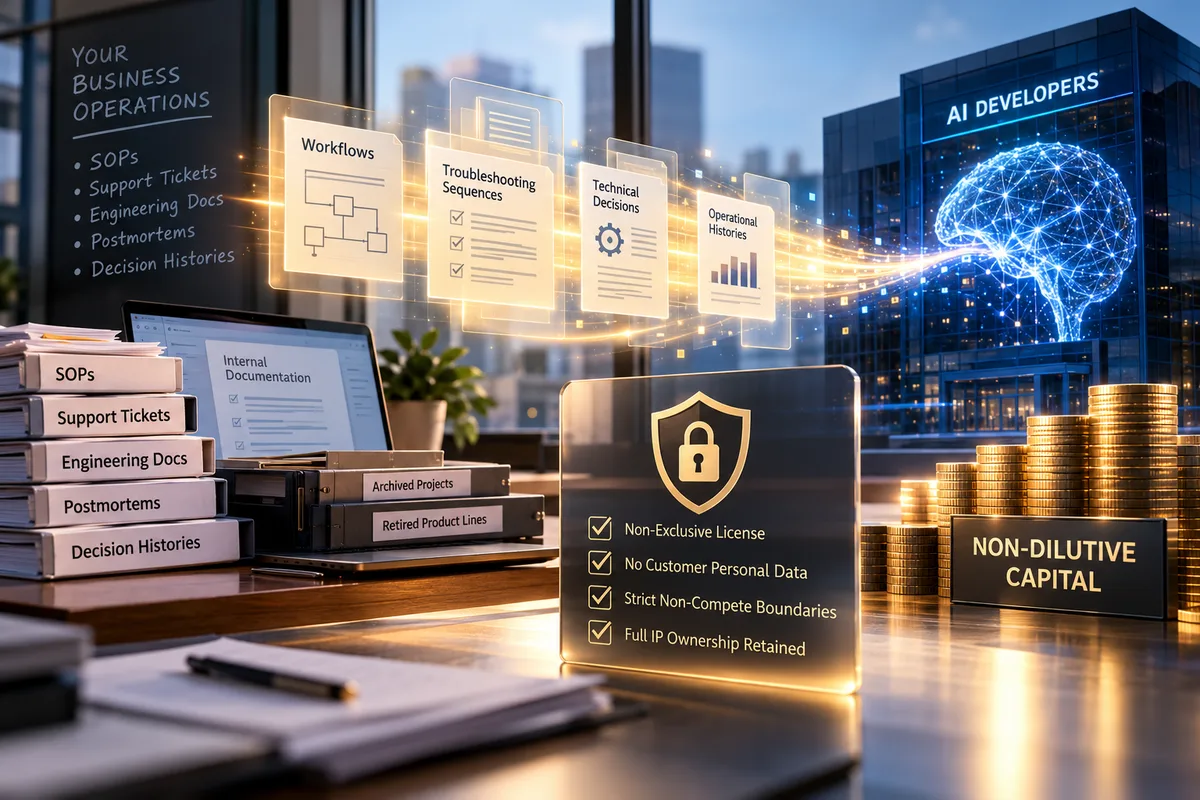
Enterprise AI acquisition programs are actively deploying capital to license authentic historical records from traditional industries:
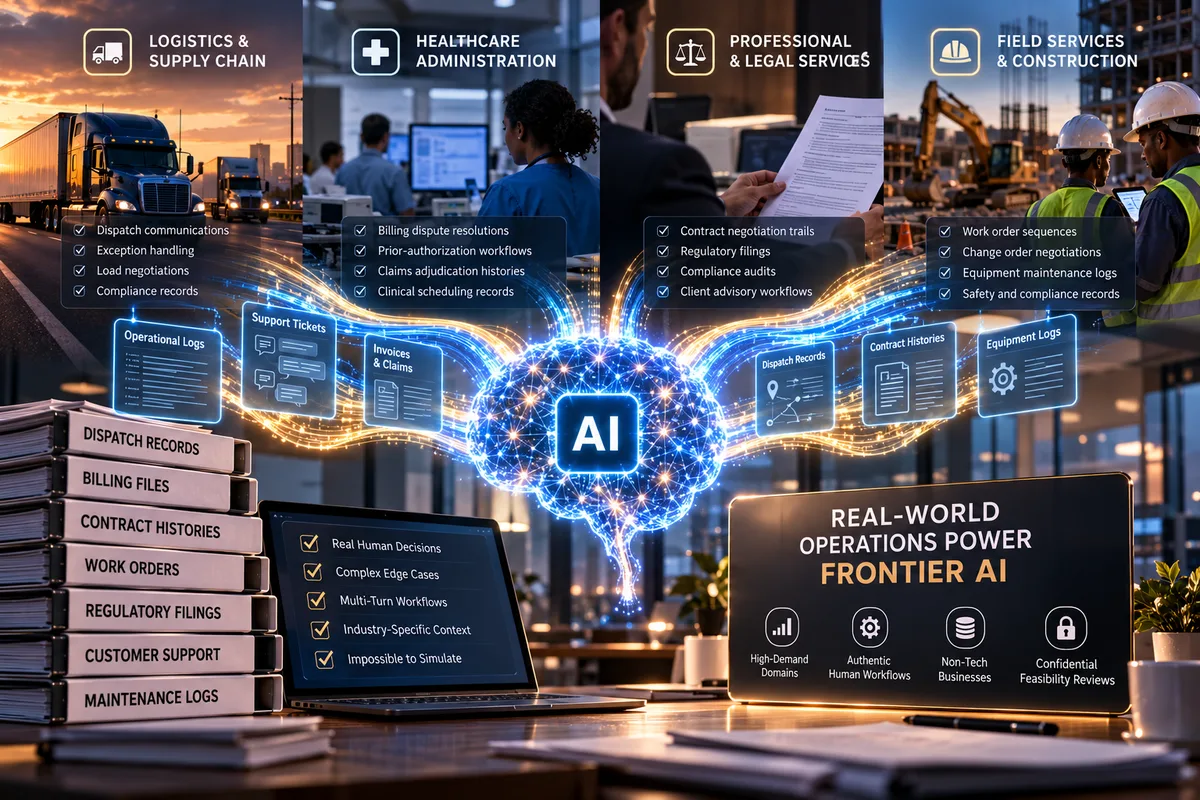
- Freight and Supply Chain Operations: Multi-year dispatch communications, exception handling workflows, load board negotiation histories, and carrier compliance verifications.
- Healthcare and Insurance Administration: De-identified billing dispute resolution trails, prior-authorization appeals, claims adjudication histories, and clinical scheduling optimization workflows.
- Professional and Legal Services: Redlined commercial contract negotiation trails, regulatory filing preparation workflows, and specialized compliance audit histories.
- Field Services and Construction: Work order dispatch sequences, change-order negotiation trails, and complex equipment maintenance troubleshooting records.
Notice what all these categories share: they are structured records of professional human decision-making. The value is not in consumer personal identities, which are strictly excluded. The value is in the diagnostic sequence, the escalation path, and the successful resolution.
The Non-Tech Founder's Hidden Advantage
Founders of traditional, service-oriented, or operational businesses often believe their records are too mundane to carry monetary value. You look at ten years of resolved customer inquiry tickets or vendor dispute logs and see administrative clutter.
An AI research engineer looks at those same records and sees a goldmine of domain-specific reasoning steps.
Because these records are locked inside private corporate silos rather than published on the open web, they are extraordinarily scarce. While software engineering data is widely available, five hundred thousand authentic, multi-turn freight negotiation logs are almost impossible for an AI developer to find.
That scarcity creates leverage for business owners.
Exploring Value Safely and Confidentially
Select third-party enterprise data acquisition programs advertise potential compensation ranging from $100,000 to $2 million or more for qualifying historical datasets. This range represents advertised programs for select, high-volume, structured packages; it is never a minimum or guaranteed payment. Whether an opportunity exists depends strictly on current training roadmaps, data cleanliness, and clear legal licensing authority.
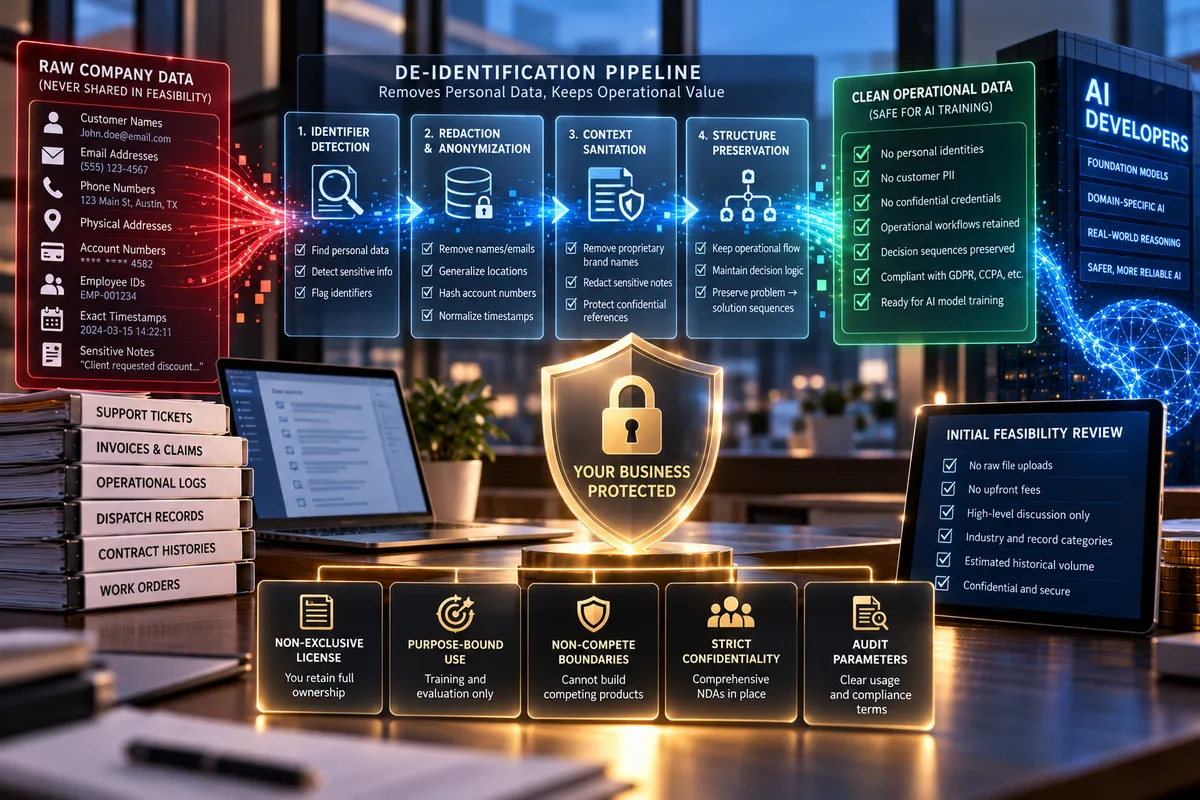
Importantly, finding out whether your business records qualify does not require exposing your operations to competitors or sharing customer personal data.
At Loredom, initial feasibility is evaluated through high-level discussions about your industry vertical, the types of operational records you maintain, and the estimated historical volume. You never upload proprietary databases or private client records to an automated system.
You do not need to be a software company to hold valuable technological assets. If your company spent years navigating the complex realities of traditional commerce, the operational knowledge you accumulated is an asset the modern AI economy is actively seeking to license.