Active Companies
The Non-Dilutive Balance Sheet: How Operating Companies Monetize Internal Workflows Without Giving Up Equity

Every founder and chief executive officer understands the harsh arithmetic of the modern capital markets.
A few years ago, growth-stage capital was plentiful and relatively cheap. Today, securing a bridge round, extending your runway, or financing a strategic pivot often requires painful concessions. Down rounds damage team morale. Heavy liquidation preferences put founder equity at risk. Venture debt comes with strict covenants, warrants, and rising interest burdens.
As a result, operators are forced to scrutinize every line of their profit and loss statement, cutting experiments and trimming headcounts just to protect their cash runway.
Yet most operating businesses sit on a substantial, completely unmonetized asset that never appears on a standard balance sheet: their internal operational history.
The Hidden Value in Daily Execution
Over years of day-to-day operation, a business produces an enormous volume of institutional knowledge. Your team writes internal standard operating procedures. Your customer success leads document complex dispute resolutions. Your engineering and product managers record architectural trade-offs, system refactoring postmortems, and edge-case integration logs.
To your own organization, these files are simply the byproduct of running the company. They reside in internal Notion workspaces, private documentation wikis, customer support ticket archives, and archived code repositories. Once a project concludes or a product line is retired, that documentation rarely gets touched again.
To enterprise artificial intelligence developers, however, that documentation represents an invaluable training asset.
The race to develop vertical artificial intelligence models has entered a new phase. Frontier models have already consumed the public internet. They understand public prose and basic software syntax. What they lack is internal enterprise context: how real businesses diagnose operational breakdowns, navigate regulatory hurdles, and make complex decisions under pressure.
They cannot generate this knowledge synthetically. When AI developers attempt to create synthetic operational records, the resulting models fail when deployed into real-world enterprise environments. The only training source that works is authentic human operational history.
How Non-Exclusive Licensing Works
When founders first hear about enterprise data licensing, their immediate concern is control. Will licensing our workflows expose our competitive advantages? Will it dilute our product value?
The answer lies in the structure of modern enterprise data licensing.
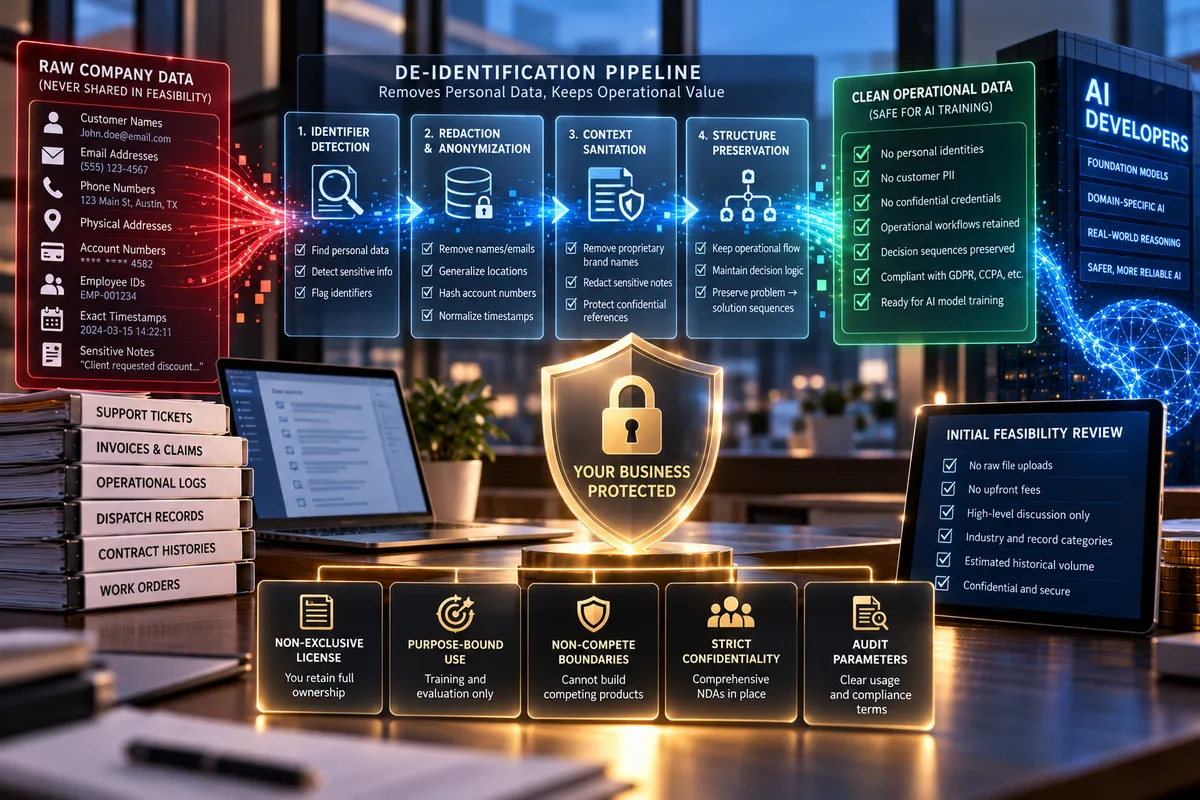
First, commercial licensing agreements are non-exclusive. You do not sell the rights to your technology, your branding, or your customer relationships. You retain complete ownership of all your intellectual property. Your software continues running, your customers notice zero difference, and your product roadmap remains entirely under your direction.
Second, the data licensed is operational, not competitive. Frontier AI labs are not looking to build a clone of your application. They are training generalized reasoning engines to understand how business functions operate across industries. Licensing your historical dispute resolutions or system triage documentation does not enable a competitor; it simply provides generalized training material for foundational models.
Third, the capital generated is completely non-dilutive. You do not grant board seats, you do not issue preferred stock, and you do not surrender future equity. For an operating company navigating a tight cash environment or funding an internal research initiative, a six-figure or seven-figure licensing partnership can provide meaningful runway without diluting the cap table.
Protecting the Core Business
A disciplined licensing process maintains strict boundaries between licensable operational records and proprietary commercial secrets:
- Zero Customer Personal Information: Reputable enterprise buyers explicitly exclude customer personal data. Names, payment credentials, personal email addresses, and confidential client files must be stripped or excluded entirely.
- Retired Business Lines: Many companies have sunsetted specific features, products, or regional pilots. The codebases, customer support trails, and architectural workflows from those retired efforts carry significant training value while posing zero competitive risk to your active core product.
- Strict Confidentiality Firewalls: Every review and transaction is governed by comprehensive non-disclosure agreements, ensuring that your corporate identity and operational specifics remain private.
Assessing Your Company's Opportunity
Select third-party enterprise data acquisition programs currently advertise potential compensation ranging from $100,000 to $2 million or more for qualifying operational packages. Compensation is never guaranteed, and qualifying depends entirely on buyer demand, industry relevance, volume, and clean legal authority.
Evaluating your options does not require handing over raw files, opening your production databases, or paying upfront advisory fees. A feasibility review begins with high-level descriptions of the record categories your business generated.
If your company has spent years building deep operational systems, you have created more than a software product or a service line. You have built an institutional knowledge base that frontier technology developers are actively looking to license.