Data Privacy
Licensing Without Risk: The Operator's Plain-English Guide to Privacy, Anonymization, and Safe Data Licensing
For any responsible business owner or technology officer, the phrase "data licensing" immediately triggers an alarm.
You have spent years building your business. You have earned the trust of your clients, complied with state and federal regulations, and guarded your intellectual property. The thought of licensing company records to third-party technology developers sounds, at first glance, like a compliance nightmare.
What about our customer confidentiality agreements? What about privacy regulations like GDPR and CCPA? What if a competitor accesses our operational playbooks?
These are exactly the right questions to ask. The business landscape is full of cautionary tales involving reckless data sharing and careless security shortcuts. If data licensing required compromising customer trust or violating privacy statutes, no serious operator would consider it.
Fortunately, modern enterprise artificial intelligence licensing operates on a completely different paradigm. Understanding how to protect your organization begins with recognizing why AI buyers actively demand clean, anonymized records.
The Liability of Personal Information
There is a widespread misconception that artificial intelligence companies want access to personal data: consumer names, phone numbers, home addresses, or financial account details.
The commercial reality is the exact opposite.
To an enterprise AI developer, personal identifiable information is toxic waste. Under modern privacy frameworks, training a foundational model on unverified consumer personal data exposes the developer to catastrophic regulatory penalties. In several high-profile cases, regulatory bodies have mandated the total deletion of trained algorithmic weights because the training corpus included illicit personal data.
AI research labs do not want to know who your individual customers were. They do not want customer lists for marketing purposes. What they need is the cognitive structure of the work: how a customer support engineer diagnosed a software configuration conflict, how an inventory manager reallocated stock across warehouses, or how a legal specialist identified contradictory clauses in a commercial lease.
The commercial value resides entirely in the operational logic, while personal identities are an active liability that must be removed.
The Anatomy of a Clean De-Identification Pipeline
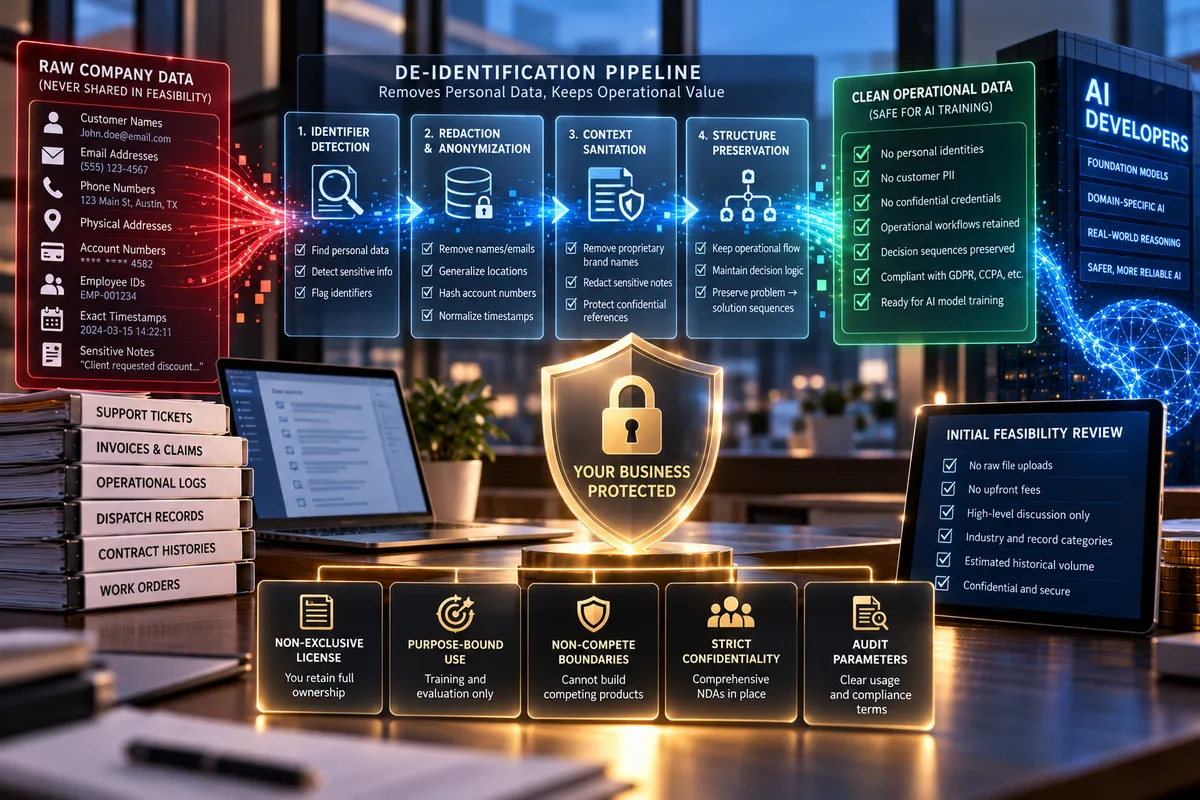
Before any operational dataset is transferred to an enterprise training environment, it passes through a multi-stage de-identification and sanitation pipeline:
- Direct Identifier Extraction: Every direct personal identifier is permanently removed. This includes individual names, email addresses, phone numbers, employee identification numbers, and physical addresses below the state level.
- Indirect Identifier Generalization: High-granularity data points that could allow triangulation, such as exact transaction timestamps or unique corporate account numbers, are generalized or hashed into abstract sequence tokens.
- Contextual Redaction: Automated linguistic models scan conversational text to identify and redact accidental mentions of proprietary brand names, personal relationships, or confidential internal credentials.
- Structural Integrity Preservation: While human identities are eliminated, the operational relationship between steps remains intact. The problem description, the diagnostic questions, the intermediate troubleshooting steps, and the final resolution preserve their logical flow.
The result is a clean, compliant operational dataset that provides maximum training utility for the AI developer while offering zero exposure for your past or present clients.
Establishing Contractual Firewalls
Technical scrubbing is only the first line of defense. Commercial licensing transactions must be reinforced with ironclad legal protections:
- Non-Exclusive Structure: You grant a limited, non-exclusive license for model training purposes only. You retain absolute ownership of your core systems, your trademarks, and your operational files.
- Purpose-Bound Covenants: The purchasing lab is contractually restricted from using the data for any purpose other than training and evaluating algorithmic models. They cannot resell your raw data, redistribute it to third parties, or use it for commercial sales outreach.
- Non-Compete Boundaries: Contractual carve-outs ensure that the licensed materials cannot be utilized to develop targeted competitor applications designed to displace your active product or service lines.
Conducting a Risk-Free Preliminary Review
One of the most critical safety rules in data licensing is simple: never upload proprietary databases or raw files to an unverified web platform simply to see if there is buyer interest.
Legitimate feasibility evaluation never begins with raw data. It begins with high-level parameters:
- What industry domain did the records originate from?
- What categories of documentation exist, such as customer dispute resolutions, engineering tickets, or logistics dispatches?
- What is the approximate volume of records and the date range of their generation?
- What is the corporate structure and legal authority of the operating entity?
Select third-party enterprise acquisition programs currently advertise potential compensation ranging from $100,000 to $2 million or more for qualifying historical packages. That range reflects advertised programs for select, high-volume datasets; compensation is never guaranteed, and transactions depend strictly on buyer demand and rigorous rights review.
By keeping initial evaluations high-level, insisting on professional de-identification, and establishing strict contractual firewalls, operating businesses can explore substantial non-dilutive capital opportunities without exposing their clients, their reputations, or their businesses to risk.