Founder Psychology
The Folder You Dread Opening: Moving Past the Shame of the Startup Archive Sitting on Your Desktop
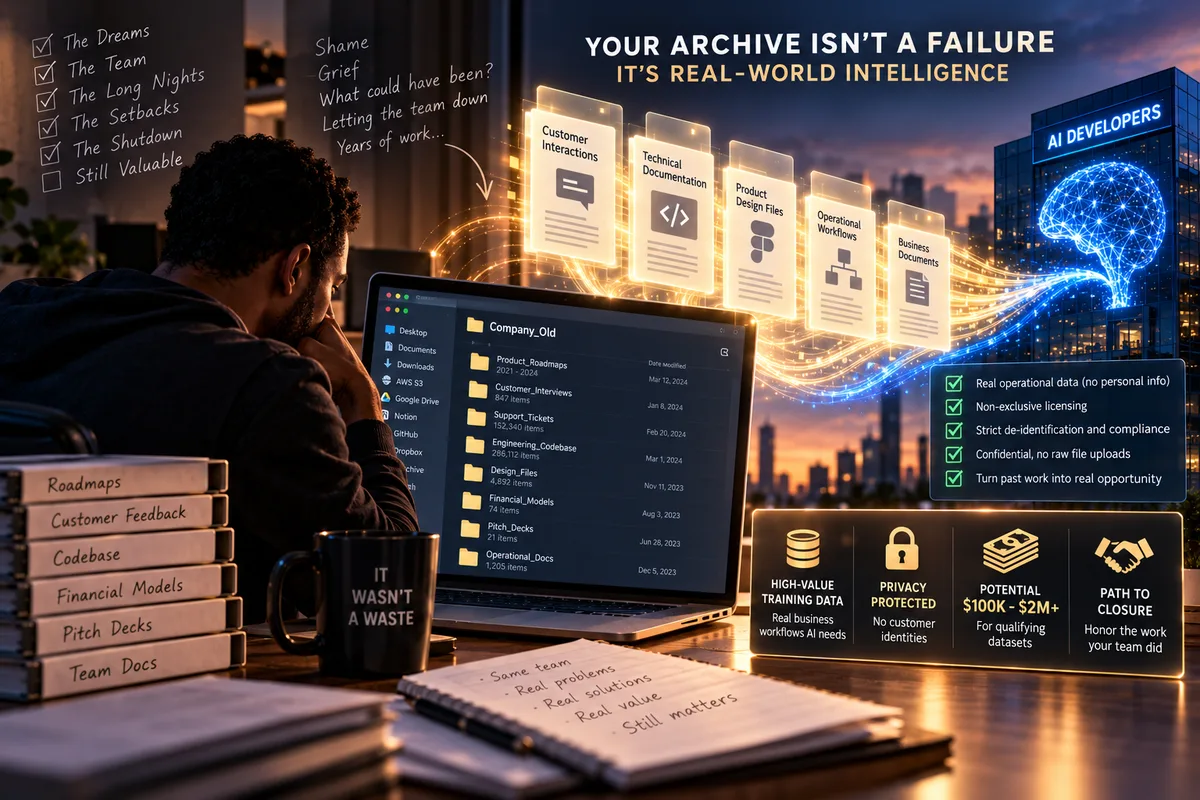
On the desktop of thousands of former founders, tucked inside a nested subfolder or stored on an encrypted external drive, sits a folder with an unassuming name.
It might be titled Company_Old. It might be called Archive_2021_2024 or V1_Backups.
You know exactly what is inside. There are hundreds of Notion strategy documents, financial models with optimistic projections that never materialized, customer interview transcripts, pitch decks presented to investors who passed, and complete database snapshots taken the night before the servers were decommissioned.
And if you are like most founders who went through a shutdown, you actively dread clicking on it.
The Digital Ghost
Opening that folder feels like conducting an archaeological excavation of your own heartbreak.
Every file carries an emotional charge. You click on a product roadmap document from 2022 and remember the optimism you felt during that quarterly planning offsite. You look at a customer feedback folder and see messages from early believers who cheered you on. You see Git repository folders containing tens of thousands of hours of architectural debates, late-night hotfixes, and refactors that kept your platform alive during traffic spikes.
Because opening the folder brings back a wave of anxiety, grief, and quiet shame, you leave it alone. It sits on your desktop like a digital ghost, a silent reminder of the years you spent pouring your soul into an enterprise that ultimately did not survive.
Yet you cannot bring yourself to delete it, either.
Every month, you might even pay five or ten dollars to keep an AWS S3 bucket active, or twelve dollars for an archived Google Workspace account. You tell yourself it is for tax records or potential legal audits. The deeper truth is that deleting that folder feels like acknowledging that four, five, or six years of your life never happened.
Reframing the Archive
The emotional barrier that prevents founders from engaging with their archives is a psychological cognitive distortion: you conflate the business entity with the knowledge it created.
When you look into that folder, your brain sees:
- A company that ran out of runway.
- Broken promises to employees and investors.
- Missed financial security and personal sacrifices.
When an enterprise artificial intelligence developer looks at that exact same folder, their engineering team sees:
- Five years of authentic, multi-turn customer problem-solving that cannot be simulated by synthetic software.
- Specialized domain workflows showing how complex commercial transactions were navigated under real economic constraints.
- Deep technical architecture documentation showing how real engineers handled edge cases, system scaling, and database migrations.
The artificial intelligence research community does not evaluate your data based on your final balance sheet. They do not care that your Series B funding round fell apart or that your customer acquisition costs rose in 2023. What they care about is empirical human intelligence: records of how skilled professionals solved real problems in a specific industry.
To you, the archive is a painful postmortem. To an AI developer, it is scarce, high-value training material.
The Irony of Modern AI Training
The great irony of the current technology cycle is that while founders are hiding their archives in desk drawers, the world's most valuable artificial intelligence research labs are running out of training data.
Public internet text is exhausted. Synthetic data creates degenerative model loops. The frontier of artificial intelligence development now relies entirely on accessing private, historical, real-world business execution records.
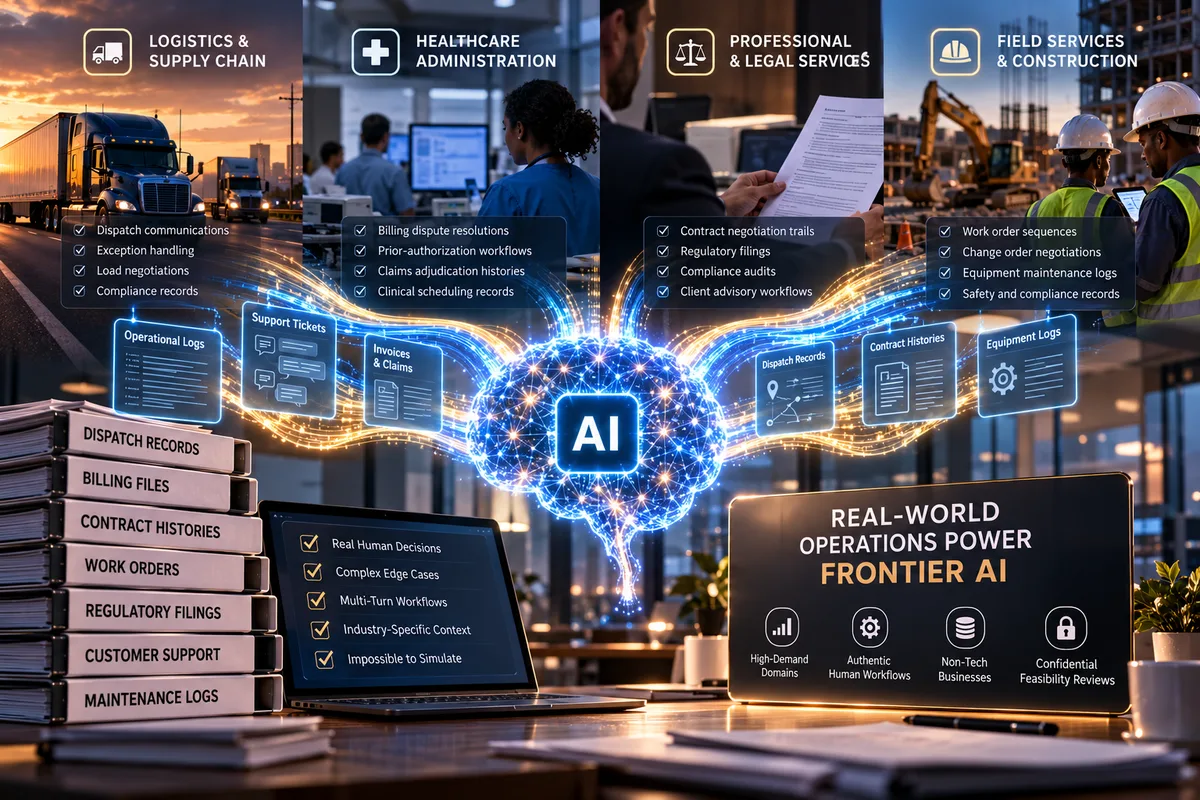
Those records cannot be created by prompt engineers in Silicon Valley. They can only be generated by teams who spent years in the trenches: answering support tickets, debugging distributed systems, coordinating logistics dispatches, and processing complex industry transactions.
The very files you dread opening contain the exact knowledge that frontier AI models need to learn how to do commercial work.
How to Evaluate Without Reopening Wounds
The thought of combing through millions of archived rows or organizing old database dumps is enough to make any former founder close their laptop. Fortunately, that is not how evaluation works.
You do not need to spend weeks organizing old files. You do not need to clean messy spreadsheets or re-architect old database dumps. Most importantly, you should never upload confidential files to an automated web tool just to see if someone might be interested.
At Loredom, feasibility evaluation is entirely human-led, confidential, and conducted without touching your raw archives:
- We start with a brief, high-level conversation about what your company built.
- We identify the broad categories of records you maintained, such as customer support threads, codebases, or operational logs.
- We assess the approximate volume and timeline of your data.
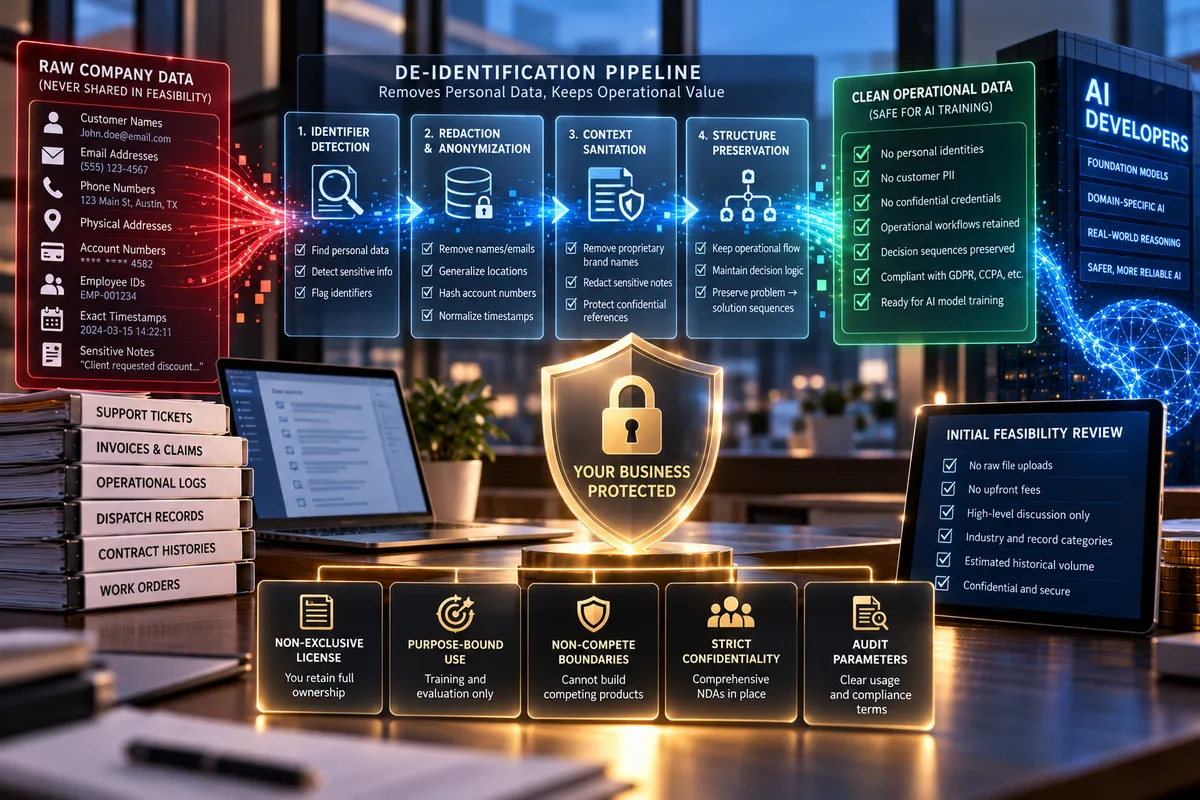
- We help confirm legal authority and explain how strict de-identification protects customer privacy before any buyer introduction occurs.
Select third-party enterprise acquisition programs advertise potential compensation ranging from $100,000 to $2 million or more for qualifying historical packages. Compensation is never guaranteed, and every opportunity depends strictly on active buyer demand, data structure, and verified licensing authority. There are zero upfront fees to explore feasibility.
Turning Mourning Into Closure
Leaving your company's records locked in a desktop folder does not protect you; it simply keeps you anchored to an unresolved chapter of your life.
The years you spent building were not an error. The systems your team designed had substance. The knowledge sitting in your dormant storage accounts has genuine commercial relevance.
Taking thirty minutes to find out whether your former company's archive matches active buyer demand is not a sign of surrender. It is a quiet, pragmatic act of self-respect: taking the work you did seriously, closing out your past obligations, and letting the knowledge you created help build the future.